
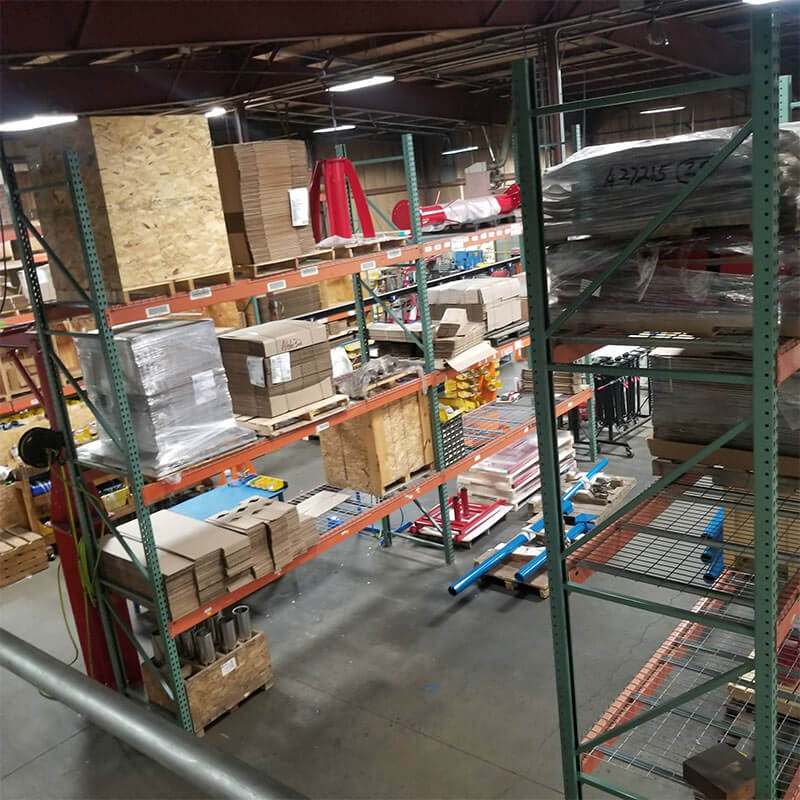
The Reality of Constant Change in Warehouses, Baggage Handling Systems, and Fulfillment Centers
The layouts and workflows in warehouses, baggage handling systems, and fulfillment centers are often in a state of flux. Seasonal peaks, product expansion, evolving order profiles, and automation solutions all play a part in driving ongoing changes. While the specifics may change, the need for high-quality lifting equipment for moving products, maintenance, and creating temporary work zones remains consistent. In order to keep up, facilities need to strategically choose the right combination of hoists — like portable and stationary davits — that can consistently meet these demands.
How Portable Davit Cranes Fit Into Flexible Operations
Portable davits can be adaptable, cost-effective lifting and positioning solutions across all kinds of facilities. They can be used across multiple workstations, often for maintenance across large areas or for shifting, short-term lift needs. The lightweight nature makes portable hoists highly maneuverable in a BHS, logistics center, or warehouse space, while toolless designs make tear down, setup, and storage fast and easy. And by using multiple types of bases — such as pedestal, rolling bases, flush-mount, or wall-mount — portable davits can accomplish a wide range of tasks. If adaptability and reliability are what your facility needs, explore high-quality portable davit solutions to find the perfect fit.
Where Stationary Davit Cranes Excel in Warehouse Settings
With fixed installation, stationary davits are limited to dedicated lifting locations, but that doesn’t minimize their utility. Stationary jibs are often perfect for equipment servicing areas, work stations that require longer reaches, and dedicated loading or unloading spaces. While stationary davit cranes do require permanent anchoring, they also have higher load capacities than portable cranes, which can be crucial for specific operations in a warehouse or fulfillment center. Find the right stationary crane for your operation by checking out Thern’s line of premium stationary davit options.
Key Tradeoffs Between Portable and Stationary Hoists
Flexibility Versus Fixed Performance
A high-functioning, efficient warehouse or fulfillment center will need a combination of stationary and portable davits to operate at its best. Portable jibs are a must for keeping up with shifting layouts, season spikes, evolving workflows, and creating temporary work areas when the need arises. On the other hand, stationary davits should be selected and customized for specifically defined lifting paths and tasks with high repeat requirements. When choosing the right crane for the job, consider how often your lift locations change within the facility and which work areas have consistent lifting needs.
Effects on Workflow and Throughput
An efficient, effective workflow is crucial for warehouses and fulfillment centers, and creating one takes the right mix of portable and stationary davits. Portable cranes are perfect for cost-effective support across multiple work areas and are easy to install in just a few minutes. On the other hand, stationary davits perform well in dedicated lifting locations to keep material moving reliably, but cannot be easily adapted for other uses if needs change. By using portable hoists for more sporadic or changing jobs, such as maintenance tasks, and stationary davits for continuous work like processing or dock loading, your facility can reach peak efficiency, maintain throughput, and remain adaptable and cost-effective.
Ergonomic Impact on Day-to-Day Operations
In addition to optimizing workflows, both portable and stationary hoists can help reduce the ergonomic challenges for workers throughout your facility. Manual handling leaves workers prone to both sudden injuries and build-up of strain, which can leave shifts with workman comp claims, labor shortages and slow throughput. Cranes make it easier and safer for workers to handle heavy loads and can help reduce injuries and downtime caused by those injuries. Additionally, portable jibs can bring lifting capacity closer to the point of work, which improves the ergonomics and comfort of operators in dynamic warehouse environments, logistic centers, and baggage handling systems.
Selecting a Hoist Strategy That Scales With Your Operation
When choosing portable and stationary davits for your facility, you must consider growth plans, the volatility of the layout, and lift frequency, in addition to load capacity requirements. In order to ensure success, calculate how each type of hoist can function within the facility’s broader handling strategy, as well as how the addition of new equipment could improve or adapt to future workflows.
If you’re ready to add lifting equipment to your warehouse or fulfillment center, check out Thern’s selection of stationary and portable davit cranes. Looking for more information? Reach out to our experts for guidance on choosing cranes, specifics about any of our products, or custom davit solutions.